A ZEISS CMM is one of the most accurate machines a shop can own, and Calypso is what turns that accuracy into actual inspection results. The catch is that Calypso fluency is a specific, in-demand skill — and when the person who has it leaves or goes on vacation, a six-figure ZEISS bridge stops earning. On-demand Zeiss Calypso programming services get it measuring parts again without you carrying a full-time metrologist for a workload that, for many shops, is genuinely part-time.
This is a practitioner’s look at what makes Calypso programming its own discipline, where shops get the most value from it, and how outsourced programming works while your data stays on your network.
Feature-based, not line-by-line — why that changes the work
Calypso’s defining trait is that it’s feature-based and object-oriented, not script-based. Instead of writing a linear sequence of commands, you define the characteristics you want — this bore, that plane, this width — by selecting geometric elements directly off the CAD model or by probing the part, and Calypso builds the measurement plan, calculates optimal travel paths, and ensures collision-free motion around them. ZEISS deliberately moved away from the code-based structured programming of the 1980s, and that’s the appeal: it maps cleanly onto how a print is dimensioned.
But “easier to learn” is not “requires no skill.” Doing it well still demands understanding measurement strategy, probe and stylus selection, datum structure, and how to get the most from ZEISS’s scanning hardware. The feature model lowers the floor for a beginner; it doesn’t raise the ceiling on the judgment that separates a routine that limps through inspection from one that’s fast, repeatable, and defensible.
The Calypso capabilities that matter most
The Safety Plane philosophy
One of Calypso’s standout features is its “safety plane” approach: it builds a virtual box around the part and automatically calculates collision-free bypass paths between features — motion that many competitor packages make you program by hand. Used well, this is what lets a routine run unattended without crashing a stylus on a clamp. Used carelessly, it’s also where programmers get lazy and leave time on the table. Knowing how to set it up for your fixturing is part of the craft.
VAST scanning — the ZEISS advantage
Where Calypso genuinely pulls ahead is high-speed scanning with ZEISS’s VAST sensors and VAST Navigator technology. Rather than discrete touches, VAST scans dense, continuous point data and Calypso intelligently determines the maximum scanning speed for the accuracy required — measuring smoothly in one run with optimized approach and travel paths. For form, profile, and freeform surfaces, this is a different league from point-to-point probing, and programming it properly (sensor choice, scan paths, point density) is exactly the kind of work shops bring in help for.
PMI-driven programming and automatic plan creation
Calypso reads Product Manufacturing Information (PMI) embedded in modern CAD models — dimensions, tolerances, datums — and can automate large parts of plan creation from it. ZEISS has reported plan generation from 3D models dramatically faster when PMI is present, and when a designer updates a tolerance in the CAD file, the measurement plan can pick that up. It’s powerful, but the auto-generated plan still needs a programmer to verify strategy, probe access, and GD&T interpretation before it’s production-ready — the automation gets you a strong first draft, not a finished routine.
GD&T, gears, and airfoils
Calypso guides the user through proper GD&T datum reference frames and ships an improving GD&T library aligned to current ISO/ASME-GPS standards. Specialized modules extend it well beyond prismatic parts: GearPro measures spur, spline, involute, bevel, and worm gears to AGMA definitions; BladePro handles turbine-blade and impeller geometry — leading/trailing edges, chord, torsion angle. If your part is a gear or an airfoil, that’s specialist programming inside a specialist package.
ZEISS CMM sitting idle?
Send your part model and print — we’ll quote the Calypso routine the same day.
Get a Free Quote →Program offline with CALYPSO Planner — the machine never stops
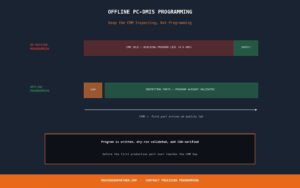
CALYPSO Planner lets a complete CNC measurement plan be created on a workstation away from the CMM, then opened and executed on the machine later. The benefit is direct: the CMM isn’t blocked for programming, so it keeps measuring parts while the routine is written elsewhere. Paired with the simulation option — which models the full CMM environment, travel paths, and potential collisions on the CAD window — a routine can be built and optimized with no machine connection at all, then proven before it ever runs live. This offline-first workflow is what makes remote Calypso programming both practical and safe.
Secure, remote, on your machine
Programming happens in your environment. We work in an offline Calypso seat from your model and print, or connect to your Calypso computer over a secure remote session, and save the finished plan straight to your system. Your prints and models never leave the building, you can watch the session live, and you can cut access at any time. For ITAR-controlled or high-security work, on-site programming is available. If you run PiWeb for reporting, routines are built to feed it cleanly.
One note on hardware: Calypso isn’t only for ZEISS
Calypso is ZEISS’s native software and is at its best on ZEISS CMMs with VAST heads, but it can also run a range of non-ZEISS machines — Brown & Sharpe, Mitutoyo, DEA, Sheffield, and some arms — via open interfaces. If you’re weighing it against the other dominant package, our PC-DMIS vs Calypso comparison lays out the real differences. We program both, so you’re covered whichever your machine runs.
When to bring in Calypso support
- Your ZEISS programmer left and inspection has stopped.
- A scanning-heavy or freeform part needs proper VAST strategy you haven’t built before.
- A gear or airfoil requires GearPro or BladePro expertise.
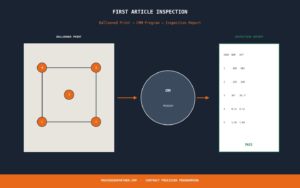
- A first article or PPAP is due with a clean ZEISS/PiWeb report.
- Demand spiked and your one metrologist is buried.
Frequently asked questions
Can you program Calypso for non-ZEISS machines?
Often, yes — Calypso can drive a range of non-ZEISS CMMs and arms through open interfaces, though it’s most powerful on ZEISS hardware with VAST sensors. Tell us your machine and we’ll confirm fit before quoting.
Do you program offline or on our CMM?
Either. CALYPSO Planner lets us build and simulate the plan offline so your machine stays free for measuring, or we connect securely for on-machine prove-out. Offline-first is usually faster and safer.
Can you handle gears or turbine blades?
Yes — via GearPro (spur, spline, involute, bevel, worm to AGMA) and BladePro for airfoil geometry. These are specialist routines and a common reason shops bring us in.
Get your ZEISS CMM measuring again.
Expert Calypso programming on demand — offline or on your machine, fast turnaround.
Get a Free Quote →