Unlocking Parametric Metrology: Scaling Part Families with ZEISS CALYPSO PCM Macros
High-mix manufacturing environments face severe administrative and operational bloat when handling complex part families. Whether your facility is inspecting a varied aerospace connector series, multi-size fluid manifolds, or precision defense components, these parts often share identical geometric profiles but scale dynamically in length, bore depth, pitch diameters, or hole patterns. The standard quality room workflow—saving independent inspection files for every single individual variation—is a massive time sink that creates a chaotic matrix of standalone revision files inside your quality department.
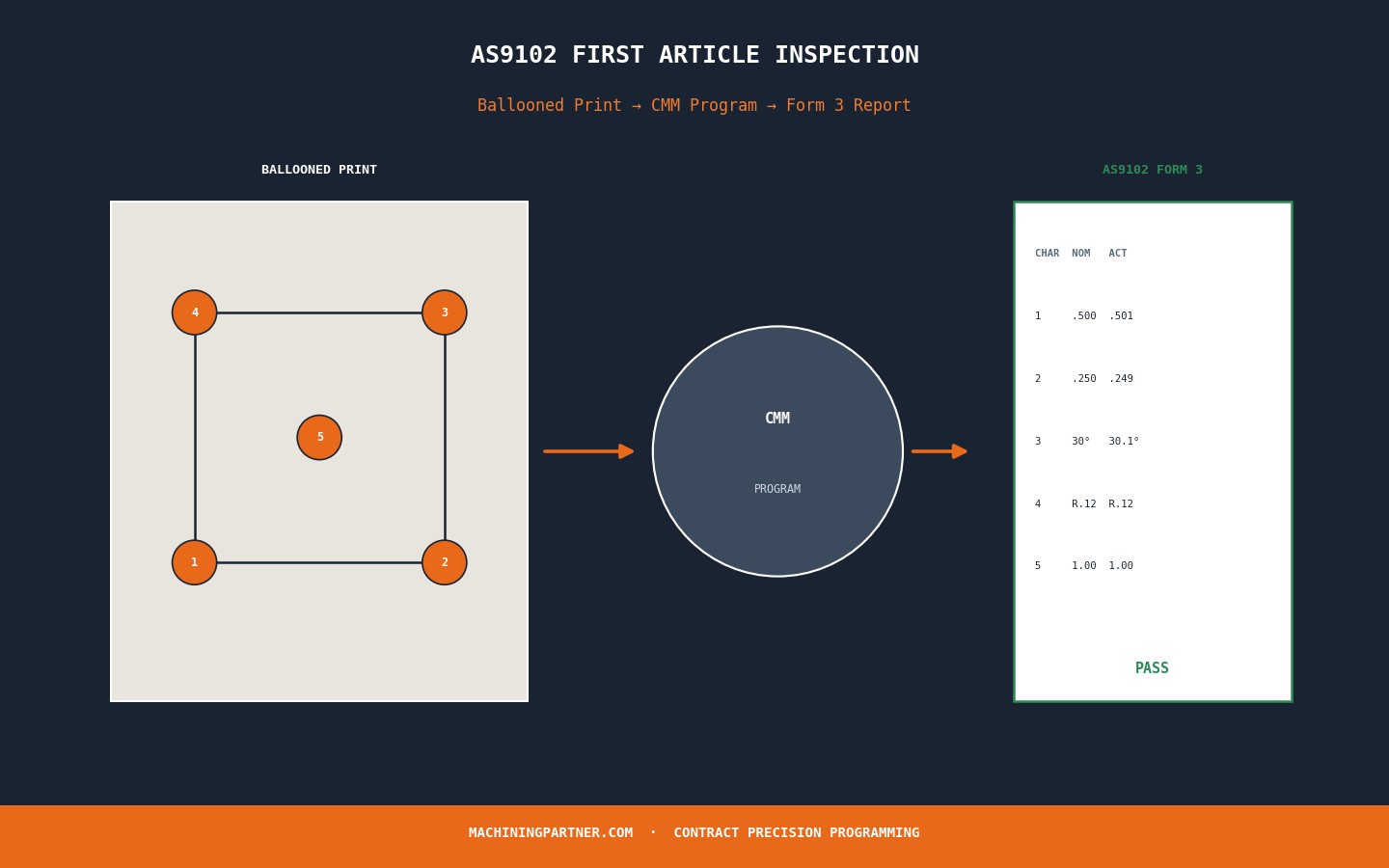
Executing complex geometric checks across these part variations shouldn’t require manual rewriting. An AS9102 First Article Inspection Report (FAIR) or high-volume batch inspection requires a characteristic-by-characteristic verification of every single dimension, note, and tolerance on the print, tied back to a specific balloon number. When your inspection scripts aren’t linked parameterically, your coordinate measuring machine (CMM) remains bottlenecked by constant code maintenance.
The Pain Point: A Contract With No Parametric Logic
If your shop handles complex part families without a robust parametric metrology framework, every new size variation turns into a scramble. Someone has to manually open a copy of an old program, hand-edit point coordinates, redefine safety boundaries, and manually transcribe results into the required reporting structures. Every single time a technician manually overrides nominal features or alters clearance planes on the fly, human transcription error creeps into your quality lab.
A single misplaced decimal point or incorrect radius value typed live at the console can cause a catastrophic stylus cluster collision, shattering an expensive ruby probe or throwing your CMM out of calibration. Miss a critical scaling characteristic or format the report output incorrectly, and the inspection protocol bounces back—stalling your delivery schedules and locking up valuable completed production lots on your shipping dock.
The Core Process Inefficiency: Manual Keystroke Vulnerabilities
When a quality lab technician is forced to maintain hundreds of independent, static measurement programs for identical part geometries, data fragmentation is inevitable. True digital thread integration removes this risk entirely by using programmatic conditional logic, allowing a single master script to dynamically adjust safety regions and probing paths based on the exact part configuration loaded on the bed.
The Solution: Parametric Control Macro (PCM) Frameworks Built around the Blueprint
Integrating advanced ZEISS CALYPSO PCM Macros replaces static, hard-coded numerical vectors with dynamic mathematical formulas and conditional (if/then) execution paths. A contract programming strategy focuses on constructing an inspection environment where the measurement routine scales automatically to match your incoming CAD geometry and print characteristics from the very first line of code.
How Automated Mapped Metrology Restructures Your Quality Flow:
- Balloon-to-Characteristic Mapping: Every feature in the master parametric CMM program is tagged directly to its corresponding balloon number on the blueprint. As the part family scales, the geometric results map directly into your inspection forms or Form 3 documentation without manual cross-referencing.
- Interactive Input Loops: Operators simply type the target variation parameters into a clean on-screen prompt interface or scan an internal barcode. The PCM macro instantly recalculates coordinate positions, stylus paths, and scanning vectors on the fly.
- Automated Clearance Matrix Defense: Safety clearance zones and probe indexing angles dynamically adjust as nominal dimensions grow or shrink, ensuring the ruby stylus never strikes unmachined stock or workholding fixtures.
Deep Dive: Advanced Math Control Inside the Metrology Lab
Precision contract programming relies on deeply embedded formula controls. Instead of defining a bore location as a static coordinate (e.g., $X=5.250$), PCM macro logic links the position mathematically to the master geometric datums. If a part family expands by an incremental step, the inspection vectors shift dynamically, executing perfect perpendicular touches ($I, J, K$) across the entire part envelope.
By evaluating the solid model parameters and print annotations together, advanced offline programming ensures your complex Geometric Dimensioning and Tolerancing (GD&T) callouts—such as composite true position paths and profile boundaries with material modifiers—remain mathematically flawless across every single dimensional variant your machine shop outputs.
| Operational Metric | Traditional Unmapped Workflow | Parametric Control Macro (PCM) Workflow |
|---|---|---|
| File Architecture | Dozens of loose, unlinked inspection files prone to mix-ups. | 1 Master File covering all part numbers in the family. |
| Setup & Execution Time | Hours spent manual editing paths for every new work order. | Under 60 seconds via clean user prompt parameter fields. |
| Crash Risk Protection | High risk from manual pendant coordinate typing overrides. | Zero (Automated, code-enforced safety envelopes). |
📩 Don’t Let a Missing Metrologist Hold Up Your Production Schedule: Discover how our contract-based Contract CMM Programming Services deliver advanced, FAIR-ready inspection code mapped perfectly to your ballooned prints.
Supporting Your Quality Management System
We act strictly as an outsourced expert technical resource to construct your metrology code. Our processes are custom-engineered to seamlessly reinforce and respect your facility’s unique internal quality management system, operating templates, and data compliance tracking boundaries. By managing the back-end mathematical logic of macro development offline, we give your team robust, collision-free execution files that drop straight into your production workflow.
One Less Reason for a Production Program to Slip
A clean, characteristic-mapped CMM program turns complex part inspections from a recurring paperwork headache into a routine deliverable. Transitioning to parametric macros eliminates manual data translation risks, optimizes your quality room throughput, and equips your manufacturing business with a repeatable, high-efficiency metrology asset for every lot that follows the first article acceptance.