Streamlining AS9102 First Article Inspections: The Value of Characteristic-Mapped CMM Programming
Winning a high-tier commercial aerospace or defense contract is a major achievement for any precision machine shop. However, the real operational challenge begins when your team must prove that every single geometric characteristic on the engineering print meets absolute design specification—in the exact, rigid format your customer’s quality management system expects. This is where facilities without a dedicated metrologist on staff start to feel intense administrative and operational pressure.
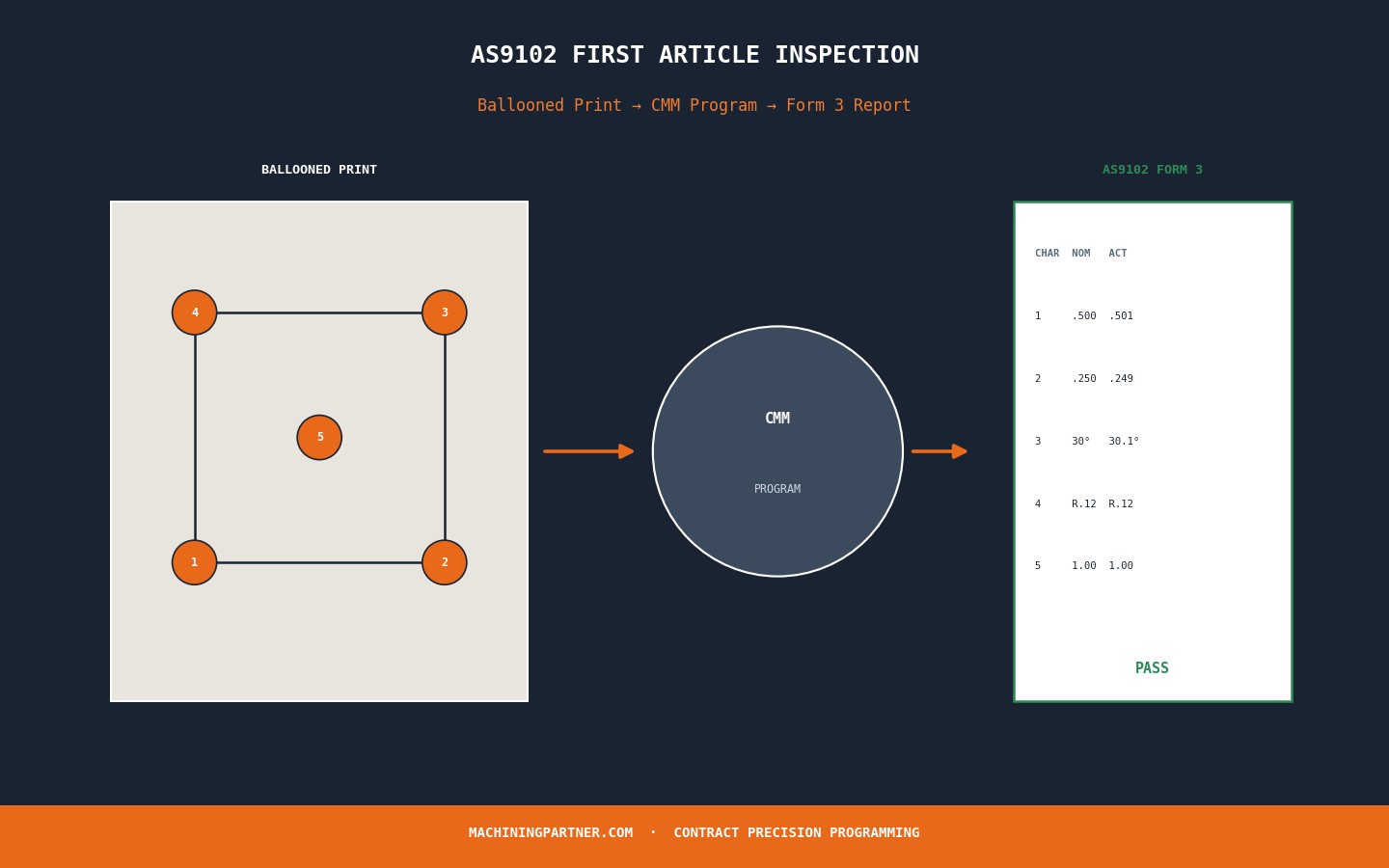
Executing an AS9102 First Article Inspection Report (FAIR) is entirely different from a standard shop-floor dimensional check. It represents an exhaustive, characteristic-by-characteristic verification of every single geometric dimension, drawing note, surface finish spec, and tolerance flag on the design print, with every single data point tied directly back to a specific balloon number on your master inspection drawing.
The Pain Point: A Tight Aerospace Contract with No In-House Metrologist
For shops lacking a full-time, dedicated metrologist, introducing a new part number with strict FAIR requirements triggers an immediate, chaotic scramble across departments. The multi-step roadblock unfolds predictably: someone has to manually balloon the 2D print, a programmer must construct a coordinate measuring machine (CMM) script capable of reliably capturing those exact geometric features, the machine must execute the measurement paths, and then someone must manually transcribe hundreds of raw measurement outputs directly into the Form 1, Form 2, and Form 3 data fields required by the customer’s quality tracking layout.
This manual, fragmented process is highly vulnerable to transcription risks, misplaced decimals, and misinterpreted datums. If your team misses a single drawing note characteristic or incorrectly formats a single data field, the entire FAIR can be instantly rejected by your customer’s quality assurance department. A bounced report stalls product acceptance, ties up high-value completed lots on your staging carts, and severely threatens your supplier rating and contract delivery metrics.
The Core Quality Risk: The Manual Transcription Bottleneck
When an operator spends full shifts manually copy-pasting numbers from a raw CMM text printout into an AS9102 spreadsheet, exhaustion sets in. Typing an out-of-tolerance value into a compliant column by mistake doesn’t just jeopardize your contract delivery metrics—it can let a non-conforming part slip into an active assembly queue. True digital thread integration requires eliminating the human typing element completely by linking the code structure directly to the engineering print boundaries.
The Solution: Inspection Programming Engineered Explicitly for FAIR Outputs
Our contract programming approach tackles the component from an entirely different angle. Instead of developing a generic inspection script and leaving the paperwork problem for later, an expert contract CMM programmer engineers the core measurement routine with the final AS9102 reporting structure as the primary objective from the very first line of code.
How Characteristic-Mapped Programming Restructures Your Quality Flow:
- Direct Balloon-to-Characteristic Mapping: Every individual geometric feature, bore location, and surface profile check constructed within the CMM script is explicitly tagged with the matching balloon index number from your print. This guarantees that your ZEISS CALYPSO, PC-DMIS, or Mitutoyo MCOSMOS output variables align completely with your engineering layout from the start.
- Automated Report-Ready Exports: Inspection data is structured to export cleanly into standardized file formats (like CSV or XML matrices) that map directly into your AS9102 compilation platforms. This eliminates the need for a separate, time-consuming data reformatting phase by hand.
- Repeatable Frameworks for Production Lot Releases: The deep value of this structured code architecture extends far past the initial approval loop. The exact same characteristic-mapped program remains on your server to handle ongoing in-process validation and final lot-release tracking, turning your initial programming investment into a permanent shop-floor asset.
Deep Dive: Managing Complex Geometric Tolerancing (GD&T)
Aerospace prints heavily leverage advanced Geometric Dimensioning and Tolerancing (GD&T) controls, such as profile of a surface, complex true position boundaries with Maximum Material Condition (MMC) modifiers, and composite datum reference frames. Programming these features offline requires an advanced understanding of mathematical metrology definitions.
By evaluating the solid model and the print annotations together, an offline technical expert sets up precise coordinate system alignments that mirror your physical datums exactly. When the CMM scans the part, the software automatically factors in material bonuses and outputs precise deviation metrics, satisfying your customer’s strict geometric auditing standards without requiring complex manual calculations from your team.
| Quality Phase | Traditional Unmapped Workflow | Automated Mapped Workflow |
|---|---|---|
| Data Extraction | CMM prints generic feature labels (e.g., “Circle 12”); requires manual print tracking. | Features are dynamically named by balloon number (e.g., “Char_042_Bore”). |
| Form 3 Compilation | Hours of manual typing and high transcription risk. | Instant, automated electronic export directly into AS9102 format templates. |
| Engineering Revisions | Requires a complete rewrite or manual patch of the physical code sequence. | Rapid model-to-print synchronization via specialized offline programming. |
✉️ Don’t Let a Missing Metrologist Hold Up Your Production Schedule: Stop losing critical delivery windows to administrative documentation hurdles. Explore how our specialized Contract CMM Programming Solutions deliver robust, FAIR-ready inspection code mapped perfectly to your ballooned prints.
Supporting Your Quality Management System
We operate strictly as an external, contract-based technical execution resource, meaning our scripts are custom-engineered to reinforce and respect your facility’s unique internal quality frameworks, operating parameters, and customer-mandated compliance boundaries. By handling the complex mathematics and back-end logic of path generation offline, we free up your on-site quality personnel to focus entirely on physical machine setups, probe calibrations, and running production lots cleanly through the inspection cell with complete peace of mind.
One Less Reason for a Production Program to Slip
Deploying a clean, characteristic-mapped CMM program fundamentally changes your shop-floor dynamics, turning AS9102 execution from a recurring paperwork headache into a predictable, routine deliverable. Protect your delivery timelines, eliminate manual typing errors, and equip your quality department with a repeatable inspection asset that delivers continuous value across every single production lot that follows the first article approval.