On aerospace and semiconductor manufacturing contracts, meeting the basic dimensional specs on a print is only half the job. The real test of a part’s compliance is its Geometric Dimensioning and Tolerancing (GD&T) profile — true position, profile of a surface, perpendicularity, and the rest. A meaningful share of CMM part rejections in precision shops aren’t caused by bad machining at all. They’re caused by an incorrect datum alignment strategy on the inspection side.
The Pain Point: The False Rejection Loop
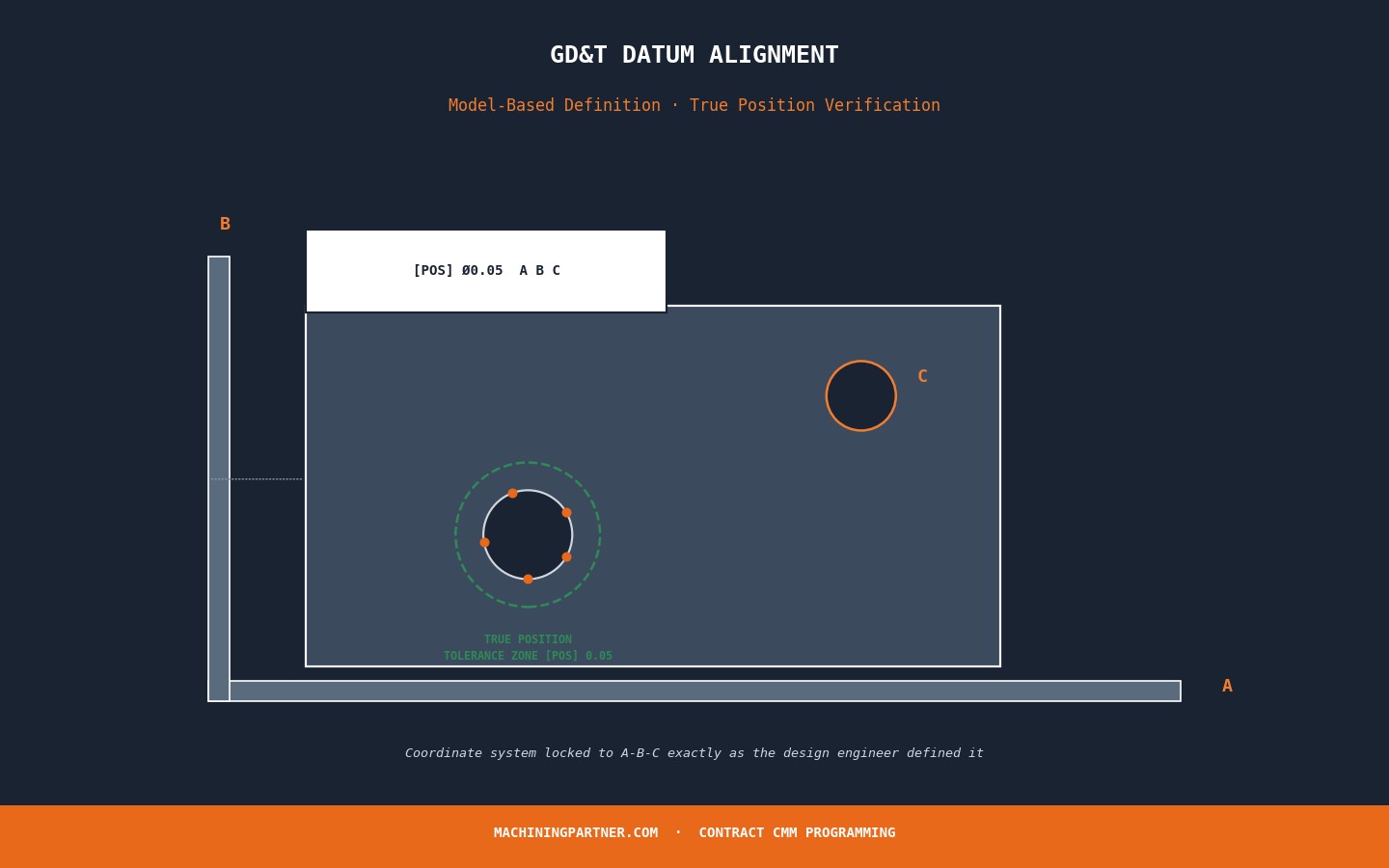
If a program builds its datums from raw physical touch points, probe-by-probe, without correlating the resulting coordinate system back to the print’s primary, secondary, and tertiary datums, the whole mathematical alignment shifts. A perfectly machined part can fail a true position check on a bore simply because the inspection alignment doesn’t mirror the part’s actual functional assembly constraints. Chasing down the root cause of these false failures burns engineering hours and triggers tool adjustments that were never actually needed.
The Solution: Model-Based Definition and Precise Feature Alignment
The fix is to stop manually translating datums by hand and instead build the alignment directly from Model-Based Definition (MBD) — pulling exact coordinates straight out of the native 3D STEP or IGES file in PC-DMIS CAD++ or ZEISS CALYPSO.
- Plane-Line-Point Stabilization from the Solid Model: Mapping features directly to the original CAD geometry locks down all six degrees of part freedom with mathematical precision — so the inspection evaluates the part exactly as the design engineer intended, not as approximated by hand-picked touch points.
- Automated GD&T Evaluation: Modern metrology software reads feature control frames natively. Whether it’s a profile tolerance on a curved turbine blade or a positional check under Maximum Material Condition (MMC) bonus tolerance, the software calculates the value directly — no manual math, no interpolation error.
📐 Lock Down Your Tolerance Compliance: See how our model-based CMM inspection programming eliminates false failures and delivers print-accurate scripts to your shop.
Eliminate Quality Friction Immediately
Running model-linked inspection routines brings real clarity to your data. Audits proceed cleanly, engineering revisions update without rework, and your inspection reports hold up to scrutiny — every time.