Most CAM systems can handle a 3-axis mill and a basic lathe. Where they fall apart is the machine that does everything at once — a mill-turn with a main and sub-spindle, twin turrets, a B-axis milling head, and live tooling, all cutting the same part in the same second. That class of machine is where ESPRIT EDGE has built its reputation, and it’s also where the gap between “we own the machine” and “we can actually program it” is widest. This is a practitioner’s look at what ESPRIT programming really involves, where it earns its keep, and how to get expert output without carrying a rare full-time specialist on payroll.
Why ESPRIT is the CAM shops reach for on the hard stuff
ESPRIT — now branded ESPRIT EDGE under Hexagon, built on roughly four decades of development by DP Technology — is a full-spectrum system covering 2-to-5-axis milling, 2-to-22-axis turning, wire EDM, and the multitasking machines that combine them. The reason it shows up in aerospace, medical, and energy shops isn’t marketing; it’s that very few CAM packages genuinely handle true multi-channel programming, where independent channels of the machine are executing synchronized operations on one workpiece. A manufacturing engineer at Edwards Vacuum, machining micron-tolerance one-off parts, put it plainly in a recent Hexagon case study: it was the only CAM system they found that could handle the full complexity of their mill-turn machines, including true multi-channel programming.
That capability is exactly why ESPRIT expertise is scarce. The software is powerful in proportion to how much machine complexity it exposes, and a programmer has to understand both the software and the kinematics of a specific multi-tasking machine to use it safely. The skill doesn’t transfer cleanly from a mill programmer or even from a different CAM package — which is the real reason shops get stuck.
The five areas where ESPRIT programming actually pays off
1. Multi-channel mill-turn and multitasking
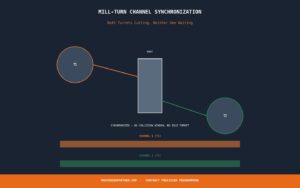
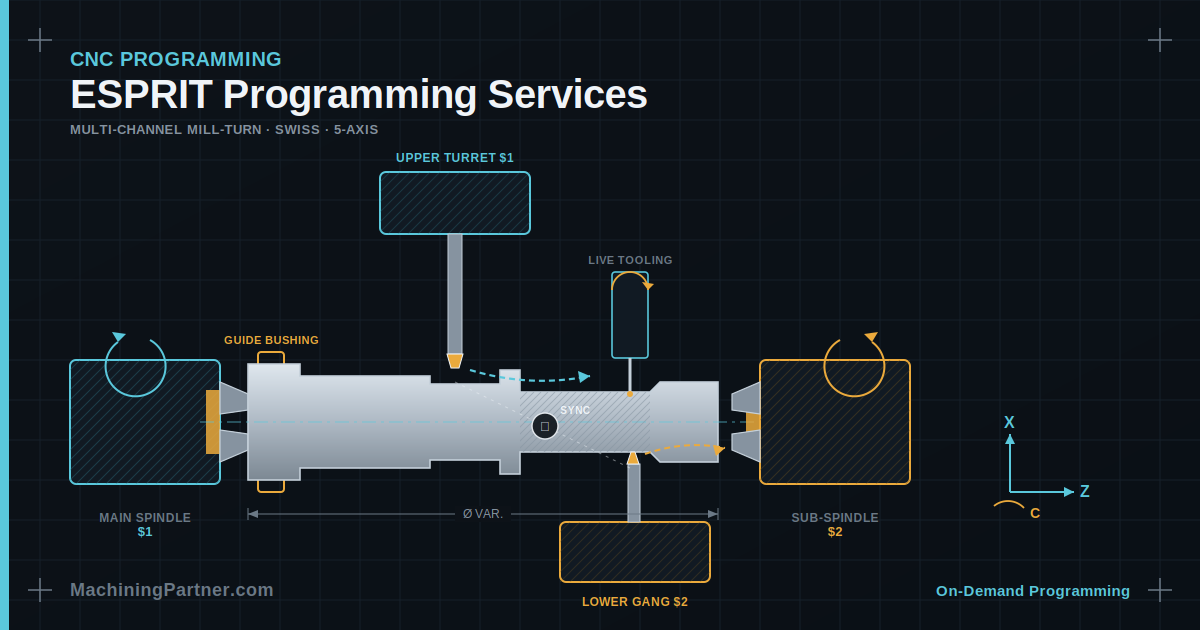
This is ESPRIT’s core strength. On a machine with multiple turrets and spindles, the hard part isn’t the cutting — it’s the choreography. Operations across channels have to be synchronized so tools don’t collide, the part is supported during transfer, and no channel sits idle waiting on another. ESPRIT’s automatic synchronization and channel-balancing tools are built specifically to time these operations so the machine runs in parallel rather than serially. Get this right and you cut cycle time dramatically; get it wrong and, as the Edwards engineer noted, a single mistake can mean weeks of downtime and tens of thousands in cost. That asymmetry — huge upside, expensive failure — is why this work belongs with someone who does it daily.
2. Simultaneous 5-axis and freeform finishing
ESPRIT’s FreeForm and Adaptive Machining cycles generate machine-optimized toolpaths for full simultaneous 5-axis as well as 4+1 and 3+2 positional work. For the complex contoured parts common in aerospace and medical — impellers, blades, anatomic implants — the toolpath strategy and tool-axis control determine surface finish and tool life as much as feeds and speeds do. ESPRIT’s patented ProfitMilling high-speed roughing strategy uses light radial engagement at full depth of cut with dynamically adjusted feed rates to hold a consistent chip load, which is what protects the tool while pushing material removal.
3. Swiss-type lathes
Swiss machining is its own discipline — guide bushings, sliding headstock, multiple channels, gang tooling, and sub-spindle pickoff for complete parts. ESPRIT EDGE added dedicated Swiss support for platforms like the Citizen L-series and Star SR-series, with configuration tools for collets, guide bushings, and tool-mounting blocks. The 2026 release went further, building multiple guide-bushing configurations directly into the machine models so a programmer can switch between setups — including chucker mode — without rebuilding the machine definition. If you’re running Swiss work, that detail alone matters, because guide-bushing strategy drives how you handle long, slender, tight-tolerance parts.
4. The digital twin and collision avoidance
ESPRIT’s digital twin isn’t a generic simulation — it’s a high-fidelity virtual model of your machine that drives real machine functions: superimposition, composite axis control, and automatic prepositioning, all verified for collision-free motion before a single line of G-code reaches the control. On a multi-channel machine where the spindle nose, a holder, or an opposing turret can foul during a synchronized move, this verification is the difference between a proven program and an expensive guess. The twin also surfaces analytics most programmers don’t check by hand: potential collisions, axis-limit exceedances, acceleration exceptions, and channel conflicts.
5. Edit-free G-code from factory-certified posts
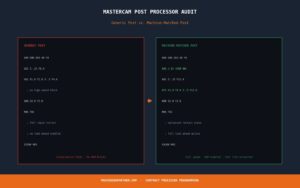
This is the part that quietly makes or breaks an ESPRIT deployment. ESPRIT ships factory-developed, OEM-tailored post processors designed to output edit-free G-code — code that runs as written without an operator hand-fixing it at the control. On a complex multi-tasking machine, a weak post is catastrophic: the toolpath can be perfect in CAM and still throw alarms or mis-time a channel handoff because the post mistranslated it. It’s why, in the same Edwards case study, the customer singled out Hexagon’s help developing a bespoke post processor as critical to making the system work. A correct post for your exact machine and control is not an afterthought; it’s half the job.
Have an ESPRIT job stuck in the queue?
Send us the machine, control, and part — we’ll come back with price and timeline the same day.
Get a Free Quote →What changed in 2026 — and why it doesn’t remove the need for a programmer
ESPRIT EDGE moved to a four-release-per-year cadence in 2026, and the headline addition is ProPlanAI — AI-assisted process planning for turning, mill-turn, and Swiss work. It accounts for stock removal and previously applied machining strategies to define processes with less manual input, with the stated goals of shortening programming time and reducing reliance on test cuts. Alongside it, Hexagon’s Copilot and ProPlanAI are explicitly positioned as a way to capture and reapply organizational machining knowledge as experienced staff retire — a direct response to the skills gap.
Here’s the honest read on that, because it’s relevant to whether you outsource or hire: AI process planning lowers the floor — it helps a less-experienced programmer get to a reasonable first pass faster. It does not raise the ceiling on judgment. Deciding how to fixture a thin-walled part, where to split operations across channels for balance, which tool-axis strategy holds a finish on a contoured surface, and whether the post is outputting safe motion — those still require a programmer who understands the machine. AI gets you a draft; experience gets you a program you can run unattended. For high-value or one-off parts, that gap is the whole ballgame.
How on-demand ESPRIT programming works in practice
The point of outsourcing isn’t to hand off your shop — it’s to get senior ESPRIT capability for the specific jobs that need it, without disrupting how your floor already runs. In practice that means we program in ESPRIT EDGE and output through your post processor (or build/fix the post if that’s the bottleneck), so the G-code drops onto your control and runs the way your operators expect. Where the part is complex or high-value, the digital twin verifies collision-free motion before delivery, and prove-out support covers the first article so the program is validated on your actual machine with you in control.
If post-processor quality is your real problem — programs that need hand-editing every run — that’s worth addressing directly, because it taxes every job that machine ever sees. We cover that under post processor customization, which on a multi-channel machine is frequently where the biggest cycle-time gains hide.
When it makes sense to bring in outside ESPRIT support
- You own the multi-tasking machine but not the programmer for it. Common, and not a failure — a Citizen or an Integrex often arrives before the person who can fully drive it does.
- A complex mill-turn or Swiss part is beyond current bandwidth. One synchronized multi-channel job shouldn’t pull your whole team off the work they already know.
- Your ESPRIT programmer left or is out. The machine doesn’t stop earning while you spend months hiring a scarce skill.
- You want knowledge-based automation set up properly. Building a speeds-and-feeds database and reusable machining strategies pays back across every future job — but only if it’s configured well the first time.
- The post is fighting you. If operators edit every program at the machine, the fix is post work, not more programming hours.
Frequently asked questions
Do you support the current ESPRIT EDGE release?
Yes — current ESPRIT EDGE (including the 2026 release line) and prior versions. Tell us your version and we match it so the program runs on your seat without compatibility issues.
Can you program Swiss and mill-turn, not just milling?
Yes — multi-channel mill-turn and Swiss-type work are exactly where ESPRIT earns its reputation and a common reason shops bring us in. Share your machine (e.g. Citizen, Star, Integrex) and control and we’ll confirm fit before quoting.
What about the post processor — will the code run on our control?
We output through your existing post so the G-code matches your control. If your post is the problem — alarms, channel mis-timing, constant hand-edits — we can develop or repair it as part of the work.
How do you make sure a multi-channel program won’t crash?
Complex programs are verified in the digital twin for collision-free, synchronized motion before delivery, and we support first-article prove-out on your machine. You always run the first part carefully — reduced rapids, single-block — as with any new program, regardless of who wrote it.
Get senior ESPRIT programming, only when you need it.
No full-time hire, no overhead — just programs that run. Tell us about the job.
Get a Free Quote →